Skip navigation.

UCSD Computer Vision

Ongoing Projects


Similarity Metrics for Categorization: from Monolithic to Category Specific

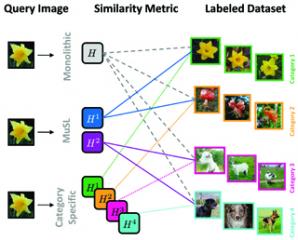
Similarity metrics that are learned from labeled training data can be advantageous in terms of performance and/or efficiency. These learned metrics can then be used in conjunction with a nearest neighbor classifier, or can be plugged in as kernels to an SVM. For the task of categorization two s...

Fire Detection in Video

Smoke detectors and heat detectors currently provide the first line of defense against catastrophic structure fires. However, these technologies are ineffective in large open spaces such as tunnels, lobbies, arenas, and in the outdoors. On the other hand, a video based fire detection system has no...

Distributed Human Computation

The ground truth labeling of an image dataset is a task that often requires a large amount of human time and labor. We present an infrastructure for distributed human labeling that can exploit the modularity of common vision problems involving segmentation and recognition. We present the different e...

Photometric Stereo

Globally Optimal Structure and Motion Estimation

In this line of work, we persent globally optimal solutions to several important problems in multiview geometry. Structure from motion problems are inherently non-convex and these works rely on efficient construction of relaxations using developments in convex optimization and algebraic geometry.

Context Based Object Categorization

The goal of object categorization is to locate and identify instances of an object category within an image. Recognizing an object in an image is difficult when images present occlusion, poor quality, noise or background clutter, and this task becomes even more challenging when many objects are pres...

Assistive Technology for the Visually Impaired

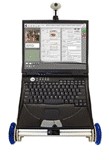
The contemporary urban environment is brimming with rich visual cues that provide valuable directional and informational content to sighted individuals. The goal of the GroZi project is to make significant advances toward making these visual cues universally accessible in a variety of real-world do...

Tracking with Online Multiple Instance Learning

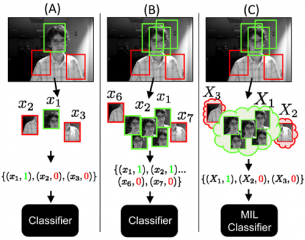
In this project, we address the problem of learning an adaptive appearance model for object tracking. In particular, a class of tracking techniques called ``tracking by detection'' have been shown to give promising results at real-time speeds. These methods train a discriminative classifier in an on...

Multiple Component & Pose Learning

This project focuses on visual learning with ambiguity. In particular, we have applied and extended the Multiple Instance Learning (MIL) paradigm to challenging computer vision problems. We propose two novel learning frameworks: Multiple Component Learning (MCL) for part-based object detection, and ...


2009


Manifold-Based Non-Rigid Structure from Motion


2008


Locally Smooth Manifold Learning

LSML is a method for determining a warping from a point on a manifold to its neighbors on the manifold. A direct application of this method is performed on video sequences where the ways of moving on the underlying manifold are learned and then used to move within and out of the training set. The wa...

Weakly Supervised Object Recognition and Localization

Multiple Instance Learning (MIL) provides a framework for training a discriminative classifier from data with ambiguous labels. This framework is well suited for the task of learning object classifiers from weakly labeled image data, where only the presence of an object in an image is known,...


2007


Visual Tracking

Theory of Illumination

Generalized Non-metric Multidimensional Scaling

Task Specific Local Region Matching

In this project we trained a distance function for local region matching. We show that when the application is relatively constrained, using a supervised learning approach produces better results than a generic system that was tuned by hand.


2006


Hypergraph Clustering

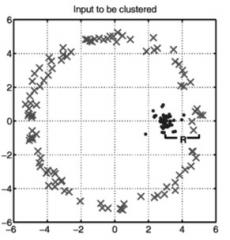
We consider the problem of clustering in domains where the affinity relations are not dyadic (pairwise), but rather triadic, tetradic or higher. The problem is an instance of the hypergraph partitioning problem. We propose a two-step algorithm for solving this problem. In the first step we use a nov...

Monitoring Animal Behavior

Smart Vivarium: automated monitoring of animal health and welfare.

Texture Synthesis and Reconstruction

Vision for Structural Biology

Reconstruction with Arbitrary BRDFs

Tissue Microarray Analysis


2005


Shape Matching

Matching with Shape Contexts and Thin-Plate Splines.

Segmentation and Reconstruction from Periodic Motion

A method for detecting and segmenting periodic motion is presented. We exploit periodicity as a cue and detect periodic motion in complex scenes where common methods for motion segmentation are likely to fail. We note that periodic motion detection can be seen as an approximate case of sequence alig...

Car Surveillance

Vehicle license plate and make and model recognition.

Icon Vectorization

Computer icons are small artificial images designed to be perceived with minimal ambiguity by the human visual system. In order to make them easier to perceive by visually impaired people, we propose a solution to the super-resolution problem for color bitmap icons in a manner that exploits the uni...

SUV Color Space

We present a photometric stereo method for non-diffuse materials that does not require an explicit reflectance model or reference object. By computing a data-dependent rotation of RGB color space, we show that the specular reflection effects can be separated from the much simpler, diffuse (approxima...

Automated CTF Estimation

In this paper we present a completely automated algorithm for estimating the parameters of the contrast transfer function (CTF) of a transmission electron microscope. The primary contribution of this paper is the determination of the astigmatism prior to the estimation of the CTF parameters. The CT...

Face Recognition


2004


Geometry of Surface Reconstruction

Refractive Optical Flow

This paper presents a novel generalization of the optical flow equation to the case of refraction, and it describes a method for recovering the refractive structure of an object from a video sequence acquired as the background behind the refracting object moves. By structure here we mean a represen...

Motion Segmentation

Particle Detection in Cryo-Electron Micrographs

A new learning-based approach is presented for particle detection in cryo-electron micrographs using the Adaboost learning algorithm. The approach builds directly on the successful detectors developed for the domain of face detection. It is a discriminative algorithm which learns important features...


2003


Mobile Robot Vision

The objective of mobile camera server (MCS)is providing a mechanism to access the (USB) camera from a remote computer. The application was primary developed to remotely request images from ER1 robot's camera. It was then extended to support multiple camera as well as AVI files, makes it more flexibl...

Structured Importance Sampling of Environment Maps

We introduce structured importance sampling, a new technique for efficiently rendering scenes illuminated by distant natural illumination given in an environment map. Our method handles occlusion, high-frequency lighting, and is significantly faster than alternative methods based on Monte Carlo samp...


2002


Spectral Clustering Using the Nyström Extension

Spectral graph theoretic methods have recently shown great promise for the problem of image segmentation. However, due to the computational demands of such methods, applications to large problems such as spatiotemporal data and high resolution imagery have been slow to appear. The contribution of th...

Chromatic Entropy

Recent interest in region based image coding has given rise to graph coloring based partition encoding methods. These methods are based on the four color theorem for planar graphs, and assume that a coloring for a graph with the minimum possible number of colors will result in the most compressible ...